
DATE: 2026-06-23 STATUS: ARCHIVE_STATION_ACTIVE
In the fast-paced world of software development and online projects, we spend a lot of time talking about “launching.” We talk about the stack, the architecture, the user acquisition, and the deployment pipelines. But we rarely talk about the other side of the coin: Decommissioning.
Every project eventually hits its end-of-life. Maybe the server costs no longer justify the utility, or perhaps you’ve simply outgrown the idea. But when you pull the plug, there is one critical component that is often forgotten: The domain name.
The “Zombie Asset” Problem
When you stop paying for a domain, it doesn’t just vanish into the ether. It eventually returns to the registrar, becomes available, and enters the “sniping” cycle. In the hands of a bad actor, that domain is a potent weapon.
Think about what that domain has touched:
- Identity Hijacking: If you ever used that domain for email—even for a single admin account—you’ve likely used it for password resets across dozens of third-party services. If a malicious actor registers your old domain, they can trigger “forgot password” flows and effectively hijack your identity.
- Trust Erosion: Your old links are still out there. They are buried in documentation, forum signatures, bookmarks, and historical GitHub commits. If those links start redirecting to phishing sites or ad-ware, the damage isn’t just to the current owner; it’s a stain on the reputation of the work you did when it was live.
- Data Leakage: We often forget what configurations remain. Residual server paths or insecure hooks can sometimes be exploited if the domain is brought back to life by a hostile party.
Digital Hygiene as a Mandate
I’ve made it a policy to treat domain renewals as a fundamental, non-negotiable line item in my budget. If I launch a project, I am responsible for its lifecycle—from the first commit to its final, secure retirement.
When I decide to stop supporting a product or service, I don’t just “let it go.” I transition it to an Archive State.
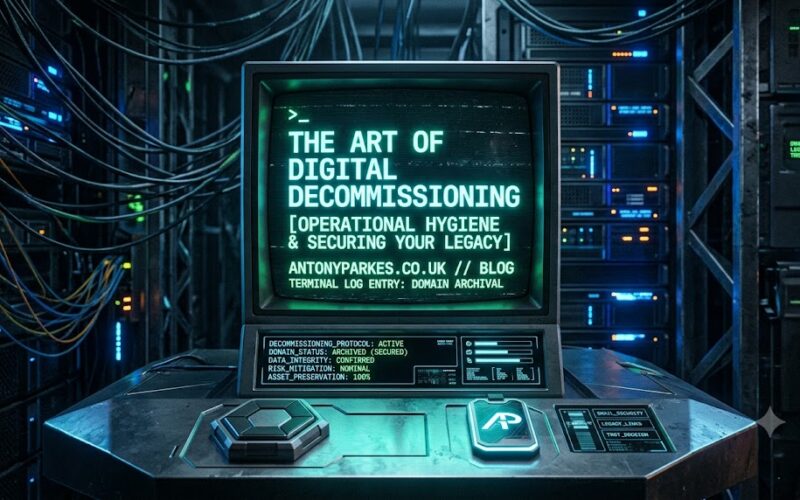
My old domains now host a simple, static terminal-style landing page. It’s not there to sell you anything or serve ads; it’s a piece of digital architecture that confirms the project is offline, the identity is safe, and the legacy is preserved. It’s a message to the internet that says: “I built this, I moved on, and I am still maintaining the perimeter.”
The Takeaway
If you are a developer, a hobbyist, or a business owner, please audit your portfolio.
- Don’t let your history become someone else’s exploit.
- Budget for the “Afterlife”: A domain registration is a small price to pay to ensure your past work doesn’t turn against you.
- Be a Responsible Owner: Secure your domains, lock down your email aliases, and maintain the integrity of your digital footprint.
Closing a project shouldn’t mean leaving the door open. Secure your legacy. Keep the registration active.
[EOF]